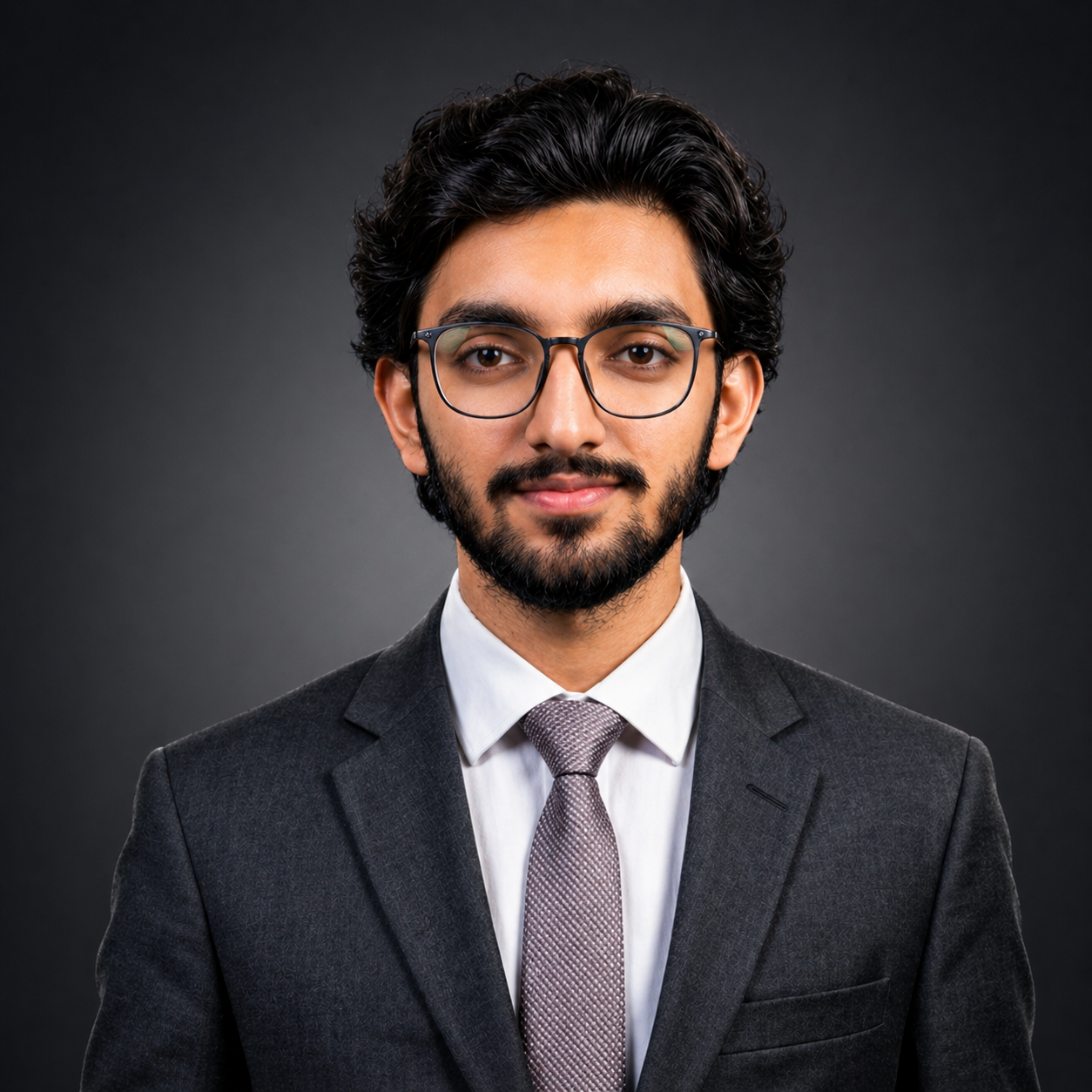
Who is Safeer Ahmad Siddiqui?
In a country where the default ambition for a technology entrepreneur has long been to build something abroad — or to build something in Karachi or Lahore at least — Safeer Ahmad Siddiqui made a different choice. He stayed in Peshawar. He co-founded LetTech (Pvt) Ltd in 2024 alongside M. Faizan Akhtar. And he set out to do something that very few Pakistani founders have seriously attempted: build an entire portfolio of AI-native SaaS products for Pakistan's most critical industries, designed and engineered from the ground up by Pakistanis, for Pakistanis.
Safeer's philosophy is captured in six words: Build in Pakistan. Build for Pakistan. It is not a marketing slogan. It is the operating premise of everything LetTech builds. The argument is simple — Pakistan's industries face problems that are uniquely Pakistani in their context, their language, their regulation, their scale, and their constraints. Imported software, retrofitted from Western markets, does not solve these problems. It creates new ones. The only way to properly solve Pakistan's industrial challenges is to build the solutions here, with deep domain knowledge, and deploy them here first.
The problem Safeer set out to solve
Spend time with Pakistani industry operators — clinic owners, school principals, HR managers at mid-sized businesses, study-abroad consultants, clinical psychologists, disaster response coordinators — and you encounter the same recurring pattern. Operations are held together by WhatsApp groups, paper files, disconnected spreadsheets, and the institutional memory of one or two overworked individuals. Critical data is not captured. Decisions are made by instinct, not insight. And when that one person leaves or burns out, the whole system wobbles.
Safeer's observation was precise: Pakistan's key industries are not underfunded — they are under-tooled. The hospitals, schools, clinics, SMEs, and government agencies that serve 240 million people are operating without the operational software infrastructure that their counterparts in every other major economy take for granted. And crucially, the off-the-shelf global SaaS solutions that exist do not fit. They are too expensive, too generic, not localised for Pakistan's regulatory environment, and not designed for the specific workflows of Pakistani operations.
His solution: build that infrastructure from scratch, in Pakistan, with AI at the core of every product — not as a feature layer, but as the architectural foundation.
The vision: making Pakistan AI-native
Most conversations about AI in Pakistan revolve around talent export — producing machine learning engineers who go on to work for Google, Meta or Anthropic. Safeer's framing is different. His vision is not to produce AI talent for the world. It is to make Pakistan itself AI-native — to reach a state where every industry in Pakistan, from healthcare to education to agriculture to small business, is running on AI-powered operational systems built and maintained domestically.
The distinction matters enormously. An AI-native Pakistan is not a Pakistan where a few thousand engineers understand machine learning. It is a Pakistan where the clinic in Abbottabad runs its patient assessments through an AI platform. Where the school in Mardan manages its fee collection, attendance, and teacher performance through an intelligent system. Where the study-abroad consultancy in Islamabad tracks every student application through an AI-assisted CRM. Where the SME in Faisalabad runs its entire operations — HR, payroll, compliance, customer management — through a single locally built platform. That is the Pakistan Safeer is building toward.
And his core conviction is that this transformation must come from within. Pakistan cannot import its way to becoming AI-native. It must build its way there.
Why local solutions matter: the import trap
Pakistan's technology sector has historically operated in an outsourcing model — Pakistani engineers build software for foreign clients, foreign companies. The economic logic was sound: dollars in, rupees out, margins intact. But this model created a structural blind spot. The best Pakistani technology talent was, by design, solving foreign problems. Pakistan's own industries went unserved.
When Pakistani businesses did try to adopt technology, they reached for imported solutions — ERPs designed for US or European regulatory frameworks, CRMs built for sales cultures that bear no resemblance to Pakistani business practices, HR platforms that do not understand local labour law or pay structures. The result was predictable: low adoption, high frustration, expensive customisation that rarely delivered, and an eventual return to spreadsheets and WhatsApp.
Safeer's argument — and LetTech's founding thesis — is that this is not a failure of Pakistani businesses to adapt to technology. It is a failure of technology to adapt to Pakistani businesses. The solution is not to import better software. It is to build the right software, here, with Pakistani domain knowledge baked in from day one.
The industries LetTech is targeting
LetTech's product portfolio is a direct expression of Safeer's industrial thesis. Each product addresses a specific, underserved sector of the Pakistani economy:
- LetPsyc targets Pakistan's clinical psychology sector — a profession with fewer than 1,000 licensed practitioners serving 240 million people, most of whom are buried in paperwork. LetPsyc is an AI-native assessment and practice management platform that gives psychologists their time back.
- EduTrack is a comprehensive school management system built for Pakistani private schools — managing fee collection, attendance, teacher performance, and student analytics in a single platform designed for how Pakistani schools actually operate.
- StudyFlow CRM serves Pakistan's rapidly growing study-abroad consultancy industry, giving agencies an AI-assisted CRM that tracks every student, every application, and every deadline.
- JobMate AI is an AI-powered recruitment and HR platform designed for Pakistani businesses navigating local labour market realities.
- DisasterSense AI is a disaster response management system built specifically for Pakistan's geography and disaster risk profile — floods, earthquakes, and climate events that are part of Pakistan's operational reality.
- ClinicOS brings smart clinic management to Pakistan's private healthcare sector, where the gap between clinical quality and operational efficiency is enormous.
- SmartSME OS is an all-in-one operating system for Pakistan's 5+ million small and medium enterprises — a sector that is the backbone of the economy and among the most digitally underserved.
No single product here is a vanity project or a copycat of a Western platform. Every one of them was conceived because Safeer and the LetTech team spent time inside the industries they target, mapped the actual problems, and designed solutions that fit. That is what "Build for Pakistan" looks like in practice.
Safeer's approach to building: problems first, technology second
What distinguishes Safeer's approach from the typical Pakistani tech founder playbook is the order of operations. Most founders in Pakistan start with a technology idea — "let's build a blockchain solution" or "let's apply generative AI to X" — and then go looking for the problem it solves. Safeer starts with the problem. He spends time in clinics, in school offices, in HR departments, in government disaster coordination centres. He maps workflows. He talks to operators. He identifies where the friction is, where data is lost, where human judgment is being substituted for the lack of any better tool.
Only after that groundwork does the product design begin. This is why LetTech's products tend to get adopted. They are not trying to change how Pakistani operators work. They are making how Pakistani operators already work dramatically more efficient, accurate, and scalable.
Transforming Pakistan's key industries: the macro view
Zoom out from the individual products and a larger pattern emerges. Safeer is not building one product. He is building a portfolio of sector-specific AI operating systems that together constitute what could become Pakistan's domestic AI infrastructure layer. Healthcare, education, recruitment, disaster response, small business, clinical psychology — these are not random verticals. They are the structural pillars of Pakistani society and the Pakistani economy.
If LetTech succeeds at the scale Safeer envisions, the cumulative effect is not just a set of successful SaaS businesses. It is a fundamental improvement in how key Pakistani institutions operate — better-run schools, better-equipped clinics, more efficient government emergency response, more competitive SMEs. Technology becomes not an end in itself but the mechanism through which Pakistani industries become genuinely world-class.
That is the "AI-native Pakistan" Safeer talks about. Not a Pakistan that talks about AI at conferences. A Pakistan that runs its hospitals, schools, businesses, and government agencies on AI-powered software, built in Peshawar and Islamabad and Karachi, by Pakistani engineers, for Pakistani problems.
Building from Peshawar: a deliberate choice
It would have been easier — by every conventional measure — to set up LetTech in Karachi or Lahore, where investor networks are denser, enterprise clients are more concentrated, and the startup ecosystem infrastructure is more established. Safeer chose Peshawar deliberately. KPK's engineering talent is strong and increasingly choosing to remain in the region. The cost structure is more favourable for a product company that needs a long runway. And building from Peshawar makes a point that Safeer considers important: the geography is not a constraint. Exceptional technology companies can be built from anywhere in Pakistan, including from cities that the national investor narrative tends to overlook.
LetTech's presence in Peshawar is, in this sense, part of the same "Build in Pakistan" thesis applied at the regional level. If the argument is that Pakistan does not need to import its solutions — that Pakistani engineers can build world-class products — then it follows that Peshawar does not need to import its startup ecosystem from Karachi either.
Connect with Safeer Ahmad Siddiqui
Safeer is active across social platforms and welcomes conversations from founders, operators, investors, and anyone working on Pakistan's technology future. You can find him at the following:
- LinkedIn: linkedin.com/in/safeer-ahmad-siddiqui — professional updates, LetTech announcements, and his thinking on Pakistan's AI landscape
- Facebook: facebook.com/safeersiddiqui17
- Instagram: instagram.com/safeerahmad_17
If you are a Pakistani operator struggling with the tools your industry runs on, Safeer and the LetTech team want to hear from you. The products LetTech builds are shaped directly by those conversations. If you are a founder or investor thinking about Pakistan's technology future, Safeer is one of the most articulate voices in the country on what it actually takes to build AI products for Pakistani industries — not hypothetically, but in practice.
What comes next
LetTech is still in its early chapters. The products are live, the first customers are in, and the feedback from those deployments is shaping the next generation of features. But the larger ambition — a full stack of AI-native operating systems for Pakistan's key industries — is a multi-year project. Safeer talks about it in terms of a decade, not a funding round.
The question he returns to most often is not "how do we grow faster?" but "are we solving the right problems?" That orientation — customer problems first, growth second — is what gives LetTech's approach its durability. Pakistani industries have been under-served by technology for decades. The opportunity for locally built, locally intelligent AI solutions is enormous. And Safeer Ahmad Siddiqui is building the company positioned to capture it — one industry, one product, one genuine problem at a time.
Build in Pakistan. Build for Pakistan. That is the commitment. And it is one of the most important commitments being made in the Pakistani technology ecosystem today.
Follow Safeer Ahmad Siddiqui
Written by the LetTech team. LetTech is a Pakistani technology company focused on solving real-life problems with AI & technology. Read more about LetTech and its founders, or explore the full product portfolio.